

Why Most Law Firm Growth Isn’t Strategic
And How Firms Can Build Quality Revenue Instead
By Bob Wiesner - Principal, Legal Practice
Most law firms say they want growth.
Partners talk about expanding client relationships.
Leadership discusses new markets.
Practice groups seek more work.
But in many firms, there is a simple question that rarely gets asked:
What kind of growth are we actually pursuing?
Without a clear answer, growth often becomes reactive.
An RFP arrives.
A relationship surfaces.
A partner sees opportunity.
A competitor stumbles.
Each individual pursuit may appear reasonable. But collectively they often produce something very different from strategy — a portfolio of work that is:
Inconsistent
Margin-sensitive
Difficult to scale
Hard to repeat
The firm may stay busy.
But busy and strategic are not the same thing.
And over time, that distinction becomes enormously important.
When “Growth” Isn’t Actually Strategy
Most firms track growth primarily through one metric:
Total revenue.
Revenue matters. But it is a misleading metric when used alone.
Because not all revenue contributes equally to a firm’s long-term success.
Some engagements create meaningful strategic value:
Strong margins
Long-term client expansion
Repeatable work
High-value credentials
Recruiting advantages
Other engagements generate very different outcomes:
Low leverage
Pricing pressure
One-off transactions
Heavy partner time
Exhausted teams
Yet in many firms, these very different outcomes are treated as equivalent.
The Problem With Treating All Revenue the Same
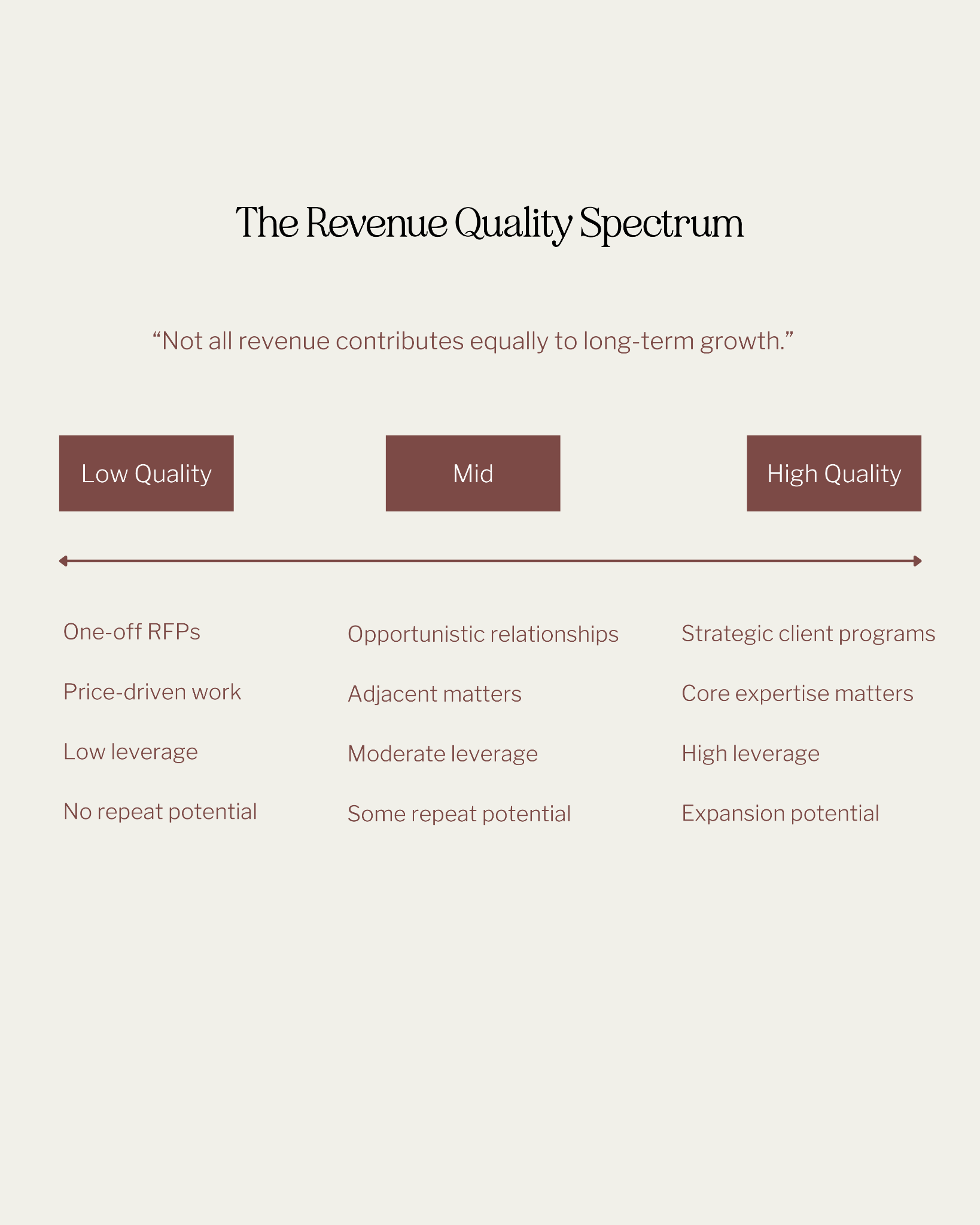
Revenue is revenue.
This is how firms unintentionally build portfolios filled with work that is:
Difficult to scale
Difficult to repeat
Difficult to price
And once that portfolio exists, it becomes even harder to change.
Why Firms Default to Quantity Over Quality
Most partners understand this dynamic intuitively.
So why do smart, experienced lawyers continue to pursue too many low-quality opportunities?
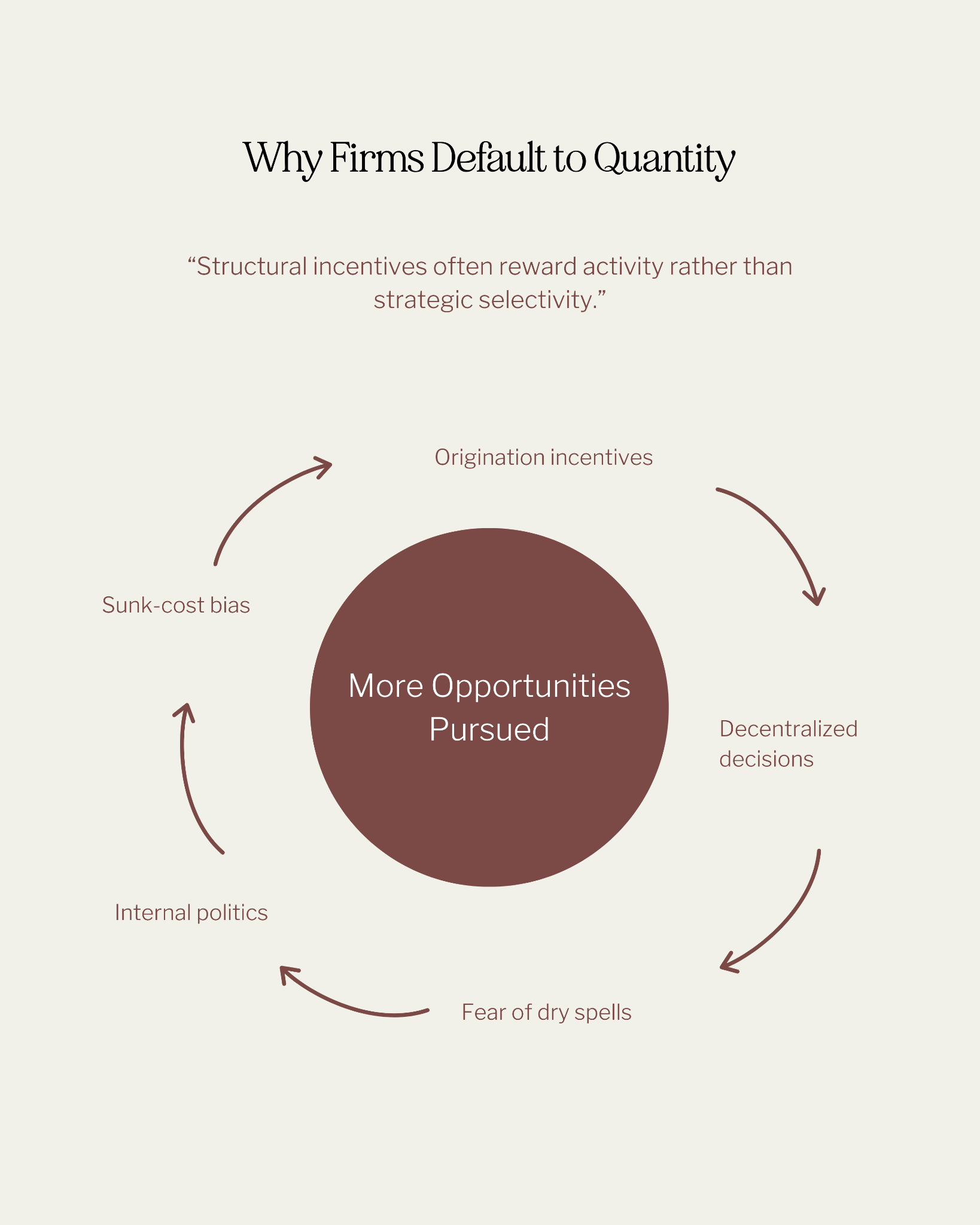
The answer usually lies in how firms are structured and incentivized.
Several forces push behavior toward volume rather than selectivity.
1. Origination Credit Systems
Many compensation systems reward individual opportunity generation, not portfolio quality.
The result is predictable:
Partners pursue opportunities because they appear — not because they fit strategy.
2. Decentralized Pursuit Decisions
In many firms:
Individual partners decide what to pursue
Practices operate independently
Leadership has limited visibility
Without coordinated decision-making, firms accumulate large volumes of loosely related pursuits.
3. Fear of the Dry Spell
Business development is unpredictable.
Even successful rainmakers experience slow periods.
This creates a natural tendency toward over-pursuit:
“If we chase enough opportunities, something will land.”
Unfortunately, the resulting work often fails to strengthen the firm’s market position.
4. Sunk-Cost Bias
Once a pursuit begins, it becomes harder to stop.
Partners may think:
“We’ve already invested time.”
“We should see it through.”
“We’re close to winning.”
Even when the strategic value is questionable.
5. Internal Politics
Few partners are criticized for pursuing too many opportunities.
Many are criticized for missing one.
So the rational response becomes:
Pursue more.
Over time, this creates a culture of activity rather than selectivity.
The Hidden Cost of Reactive Growth
When firms consistently pursue large numbers of low-quality opportunities, several things begin to happen.
Focus Becomes Diluted
Partners and business development teams spread their time across too many pursuits.
High-potential opportunities receive less attention than they deserve.
Margins Compress
Reactive opportunities often involve:
Price competition
Unfamiliar clients
Unclear scope
These engagements frequently produce lower profitability.
Teams Become Exhausted
Constant pitching and unpredictable matters create operational strain.
Lawyers spend more time responding than building expertise.
Market Position Weakens
Perhaps most importantly, reactive growth rarely reinforces a firm’s reputation in a focused way.
Instead of building recognizable strength in specific areas, the firm becomes broad but indistinct.
The Alternative: Quality Revenue
The most consistently successful firms take a different approach.
They do not treat all revenue as equal.
Instead, they focus on what we call:
Quality Revenue
Revenue that simultaneously produces:
+ Strong margins
+ Repeatable work
+ Expanding client relationships
+ Market credibility
These firms are not less ambitious about growth.
But they are far more selective about what they pursue.
The Quality Growth Framework
In practice, the best opportunities tend to exist at the intersection of three elements.
1. Work You Genuinely Want To Do
Matters that:
Leverage existing strengths
Reinforce strategic practices
Build recognized expertise
These engagements compound value over time.
2. Clients You Genuinely Want To Serve
Clients who:
Value partnership
Provide repeat opportunities
Fit the firm’s long-term market focus
These relationships produce durable revenue.
3. Profit You Genuinely Want To Earn
Work that allows:
Confident pricing
Appropriate leverage
Sustainable margins
Not simply top-line revenue.
When these three factors overlap, firms find the opportunity for quality growth.
Outside that intersection, work may still exist.
But advantage often does not.

Practical Implications for Firm Leadership
Firms that adopt a quality-growth mindset often begin making different decisions about:
Pursuit Prioritization
Instead of chasing every opportunity, leadership focuses on those that align with strategy.
Resource Allocation
Senior talent is concentrated where it matters most.
Not dispersed across dozens of marginal pursuits.
Pricing Discipline
Strategically aligned work allows firms to price with greater confidence.
Declining Opportunities
Perhaps most importantly, firms become more comfortable saying:
“This is not the right opportunity for us.”
That discipline protects both time and reputation.
Strategic Selectivity Does Not Mean Zero Opportunism
Every firm benefits from some opportunistic work.
Unexpected matters can:
Introduce new clients
Build relationships
Open doors to future work
The goal is not eliminating opportunistic pursuits.
The goal is controlling their proportion.
When too much growth is reactive, firms lose the capacity to pursue strategically important opportunities.
Reducing some opportunistic pursuits frees up:
Partner attention
BD resources
Strategic focus
For opportunities that matter more.
The Payoff
When firms shift from reactive growth to quality revenue, the results often include:
Higher margins
Fewer but stronger pursuits
Deeper client relationships
Clearer market positioning
In simple terms:
Pitch less. Win more.
Conclusion
Most law firms do not lack ambition.
What they often lack is a clear definition of quality growth.
Without that definition, firms naturally default to:
More pursuits
More activity
More revenue
But not necessarily better outcomes.
Firms that define the type of growth they want — and align pursuit decisions accordingly — build something more powerful:
Revenue that compounds.
And over time, that distinction becomes one of the most important competitive advantages a firm can develop.

Bob Wiesner
Principal, Legal Practice
Bob has been advising clients on business development pursuits for nearly 30 years. In that time, he’s helped his clients win billions of dollars worth of contracts. In his role as a pursuit and pitch consultant, his clients have won 80% of the time.
Bob’s client work fits in all areas of marketing communications. He’s also advised firms in sectors such as management consulting, law, financial services, accounting, financial services, and others. He’s consulted on Olympic bids, defense contracting, and IPO/fundraising.